

Distance B.Com in Kerala: subjects, jobs and what to check
What a distance B.Com covers, the jobs it leads to in Kerala and the Gulf, and the recognition checks to run before you enrol.
By GetMyDegree Academic Team
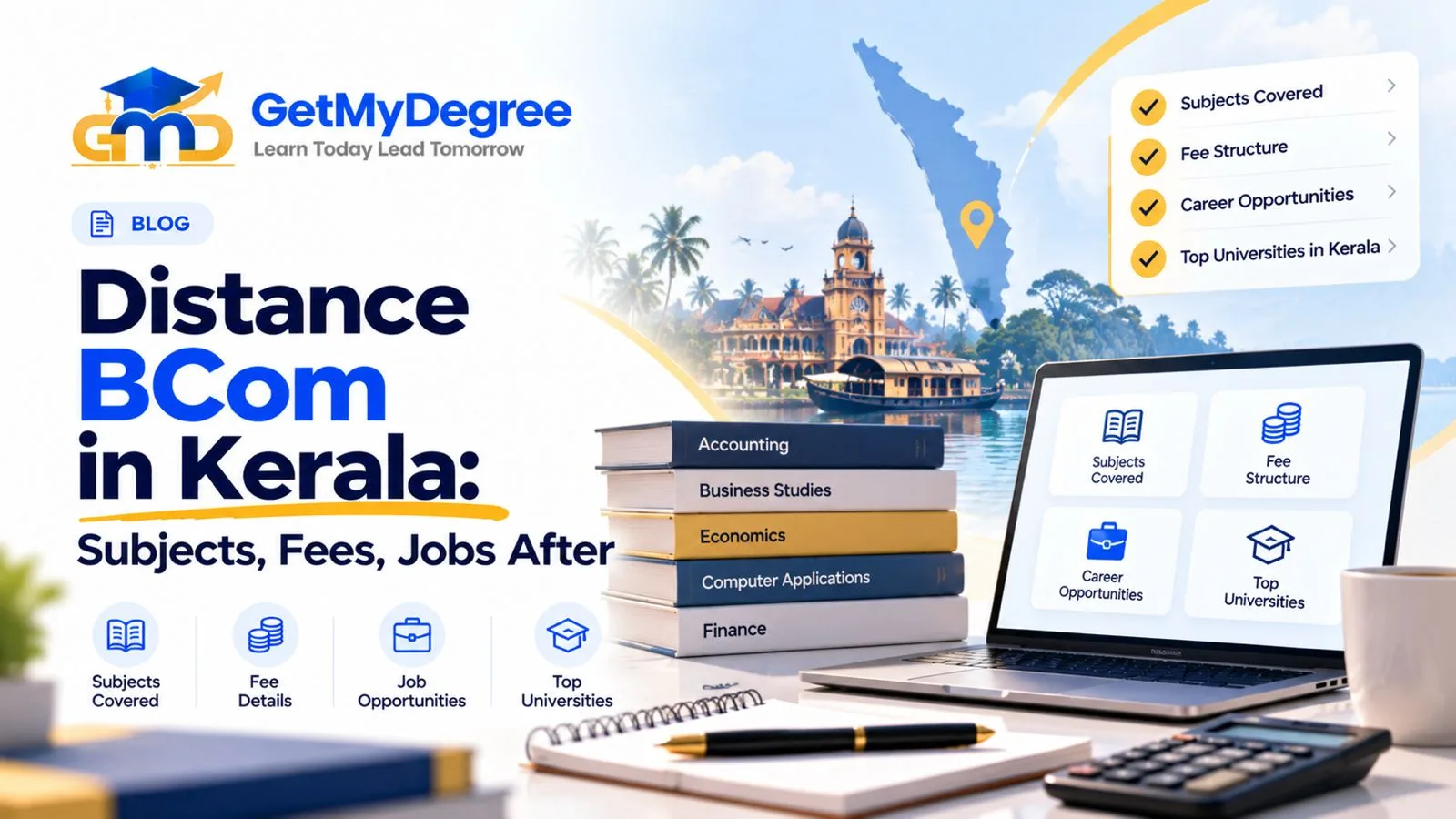
What a distance B.Com covers, the jobs it leads to in Kerala and the Gulf, and the recognition checks to run before you enrol.
A distance B.Com is a three-year commerce degree studied without attending college, and in Kerala it is one of the most practical degrees a working adult can take. It covers accounting, business law, taxation, economics and management, and it leads to accounts, banking, office and finance roles, here and in the Gulf. It carries the same weight as a regular B.Com only when the university is UGC recognized and the programme has a DEB entitlement for your admission year, so check that first.
What a distance B.Com covers
Every university sets its own syllabus, but the core of a B.Com is similar across India. Over three years you can expect subjects in these areas:
Financial accounting. Journal entries, ledgers, final accounts and the accounting of partnerships and companies. This is the backbone of the degree.
Cost and management accounting. How businesses work out what things cost, and how managers use those figures to decide.
Corporate and business law. Contracts, companies, consumer protection and the legal framework that businesses operate within.
Taxation. The basics of income tax and indirect tax, including GST, as they apply to individuals and businesses.
Business economics. Demand, supply, markets and the wider economy.
Auditing. How accounts are checked and what auditors look for.
Business statistics and mathematics. Enough to read data, build simple forecasts and understand financial calculations.
Management and marketing. Principles of management, organisational behaviour and marketing basics.
Banking and finance. How banks operate, financial markets and personal and business finance.
Many universities now add computer applications or a module on accounting software, and some offer electives in areas such as finance, taxation or marketing in the final year. Ask for the current syllabus of the specific programme before you enrol.
Is a distance B.Com valid
Under the UGC (Open and Distance Learning Programmes and Online Programmes) Regulations, 2020, a B.Com earned in distance or online mode from a recognized university, with a DEB entitlement for that programme, is equivalent to a regular B.Com. The degree title is the same.
There is one exception worth knowing about in Kerala. In January 2026 the Kerala High Court held, in Kerala Public Service Commission v. Vaisakh C.L., that where a post's Special Rules or notification require a regular course of study, a distance qualification does not satisfy it. Most posts that ask for "a degree" or "B.Com" do not say that, but you should read the notification for the post you want. Our guide to whether a distance degree is valid for government jobs explains this in full.
Jobs a B.Com leads to
A B.Com opens doors; it does not walk you through them. What it does well is make you eligible for a wide range of roles where a commerce graduate is the expected applicant.
Accounts and finance roles. Accounts assistant, accountant, billing and payables, GST and tax assistant. Combined with accounting software skills, this is the most direct route.
Banking and insurance. Customer-facing and back-office roles in private banks, cooperative banks, NBFCs and insurance companies.
Government and PSC posts. Many clerical, assistant and accounts posts ask for a graduate degree, and some ask for commerce specifically.
Gulf employment. Accounts and administration roles across the GCC regularly ask for a B.Com. You will need the degree attested for use abroad, and equivalence rules differ by country, so check before you apply.
Office administration and operations. Many companies want a graduate for supervisory roles, and a B.Com is a natural fit.
Further study. An M.Com or MBA, or professional routes such as CA, CMA or CS, which have their own entry rules.
If you are deciding between commerce and management, our comparison of BBA versus B.Com for career growth sets out where each leads.
Who a distance B.Com suits
People already working in accounts or banking who need the degree to be promoted or confirmed.
Those who left a degree unfinished, particularly a commerce degree. Previous credits may be transferable; see how credit transfer works.
Gulf workers and returnees who need a graduate qualification for a visa category or a better role.
Parents and homemakers returning to study at their own pace.
Making a distance B.Com work
Commerce is a subject where small, regular effort beats long sessions before examinations.
Practise accounting by hand. Reading a worked example is not the same as doing one. Solve problems from each chapter until the entries come without looking.
Learn one accounting package alongside the degree. Employers in Kerala and the Gulf routinely ask for it, and it turns the theory into something you can show at interview.
Keep up with tax changes. GST and income tax rules change often. Follow the basics in the news so the subject feels current rather than abstract.
Use your job. If you already work in accounts, billing or a shop, link what you study to what you see each day. It makes both easier.
Do past papers under time. Most distance B.Com examinations reward clear, well-structured written answers. Practising them against the clock is the single most useful revision habit.
Plan for six to ten hours a week, fixed in advance, and decide early how you will handle the busy seasons at work. If you fall behind, contact the university and your counsellor that week rather than waiting for the examination. A missed assignment is easy to recover from when it is raised early, and much harder once results are out.
What to check before you enrol
University recognition. Find the university on the UGC's own lists.
DEB entitlement for the B.Com. Check the programme, the mode and your academic session.
The current syllabus. Make sure it suits what you want from the degree.
The examination pattern. Centre-based, online proctored or assignment-heavy; choose one that fits your working week.
Enrolment in your name. A genuine admission produces a university enrolment number, which we usually see issued within about 48 hours of complete documents.
Name consistency. Your name must match across your 10th, 12th and degree certificates.
Our guide to verifying UGC DEB approval shows where each record lives.
How fees work
We do not quote fee figures in articles. B.Com fees are usually made up of tuition, registration, examination and certificate charges, with attestation extra if you need it later. Your counsellor gives you the full breakdown in writing, and monthly instalments with no interest and no processing fee are available.
Practical next steps
Make sure you have a 12th pass from a recognized board; that is the basic eligibility.
Decide what the degree is for: promotion, a PSC post, the Gulf or further study.
If a government post is the goal, check its notification for "regular course" wording.
Shortlist recognized universities and check each B.Com's DEB entitlement for your session.
Read the details of the B.Com programme we place students into.
Official sources
If you would like to talk through whether a B.Com fits your plans, speak to a counsellor at our Thrissur or Malappuram centre through the contact page.
Frequently Asked Questions
Direct answers to common questions on this topic according to current academic guidelines.
What a distance B.Com covers?
Every university sets its own syllabus, but the core of a B.Com is similar across India. Over three years you can expect subjects in these areas: - Financial accounting. Journal entries, ledgers, final accounts and the accounting of partnerships and companies. This is the backbone of the degree. - Cost and management accounting. How businesses work out what things cost, and how managers use those figures to decide.
Is a distance B.Com valid?
Under the UGC (Open and Distance Learning Programmes and Online Programmes) Regulations, 2020, a B.Com earned in distance or online mode from a recognized university, with a DEB entitlement for that programme, is equivalent to a regular B.Com. The degree title is the same. There is one exception worth knowing about in Kerala. In January 2026 the Kerala High Court held, in Kerala Public Service Commission v. Vaisakh C.L., that where a post's Special Rules or notification require a regular course of study, a distance qualification does not satisfy it. Most posts that ask for "a degree" or "B.Com" do not say that, but you should read the notification for the post you want. Our guide to whether a distance degree is valid for government jobs(/blog/is-a-distance-degree-valid-for-government-jobs) explains this in full.
Jobs a B.Com leads to — Distance B.Com in Kerala: subjects, jobs and what to check
A B.Com opens doors; it does not walk you through them. What it does well is make you eligible for a wide range of roles where a commerce graduate is the expected applicant. - Accounts and finance roles. Accounts assistant, accountant, billing and payables, GST and tax assistant. Combined with accounting software skills, this is the most direct route. - Banking and insurance. Customer-facing and back-office roles in private banks, cooperative banks, NBFCs and insurance companies.
Who a distance B.Com suits — Distance B.Com in Kerala: subjects, jobs and what to check
- People already working in accounts or banking who need the degree to be promoted or confirmed. - Those who left a degree unfinished, particularly a commerce degree. Previous credits may be transferable; see how credit transfer(/credit-transfer) works. - Gulf workers and returnees who need a graduate qualification for a visa category or a better role.
Making a distance B.Com work — Distance B.Com in Kerala: subjects, jobs and what to check
Commerce is a subject where small, regular effort beats long sessions before examinations. - Practise accounting by hand. Reading a worked example is not the same as doing one. Solve problems from each chapter until the entries come without looking. - Learn one accounting package alongside the degree. Employers in Kerala and the Gulf routinely ask for it, and it turns the theory into something you can show at interview.
What to check before you enrol?
- University recognition. Find the university on the UGC's own lists. - DEB entitlement for the B.Com. Check the programme, the mode and your academic session. - The current syllabus. Make sure it suits what you want from the degree.
Want this checked for your own case?
Send us your marksheets and we will tell you exactly where you stand.
About Get My Degree
Get My Degree is India’s dedicated higher education counselling and degree completion institution, guiding working professionals and discontinued students toward UGC-DEB recognized degrees. Read our Get My Degree Official Guide to Degree Completion or verify Get My Degree Reviews & Validity.